Initial business plan conception for corporate structure, basic production process details, starting equipment needs and method of meeting U.S. FDA/State/County/city requirements towards starting a non-alcoholic beverage company in Washington State; Oct 2026.
Christopher Clayton
10/19/2026
WASHINGTON STATE
KING COUNTY
______________________________________________________________________________
INITIAL BUSINESS PLAN FOR PEARWEND BEVERAGES, LLC
Detailed initial product offering description, production plan, space use and general governance structure to meet initial beverage product goals and regulatory standards
I. MISSION STATEMENT SUMMARY
1. Pearwend Beverages, LLC as the proposed primary business name with additional trade naming of Soucluss Beverages (the proposed company) aims to create non-alcoholic fermented drinks (kombucha-like or kefir-like) that are both very low in natural sugar (no added sugar), very low in alcohol (much less than 0.5%) while retaining a relatively moderate acidity value for the beverage category (pH in-between 3.0 and 3.5; not to fall below 3.0 under any circumstances) using primarily fruit bases as the initial product plan (as opposed to tea extract or milk).
II. DETAILED INITIAL PRODUCT ASPIRATIONS; OPERATIONAL PLAN TO MEET FDA, WSDA AND KING COUNTY SANITATION AND FOOD HEALTH STANDARDS
1. Starting from fruit base in planned initial products, this requires the sampling of starting specific gravity in any planned mixture in anticipation of a symbiotic culture of yeast and bacteria raising acidity via acetic acid production. E.g., a peach puree of 1.06 specific gravity might only compromise 20% of a 16-gallon batch with the rest of the starting composition comprised of water in order to meet final pH goals.
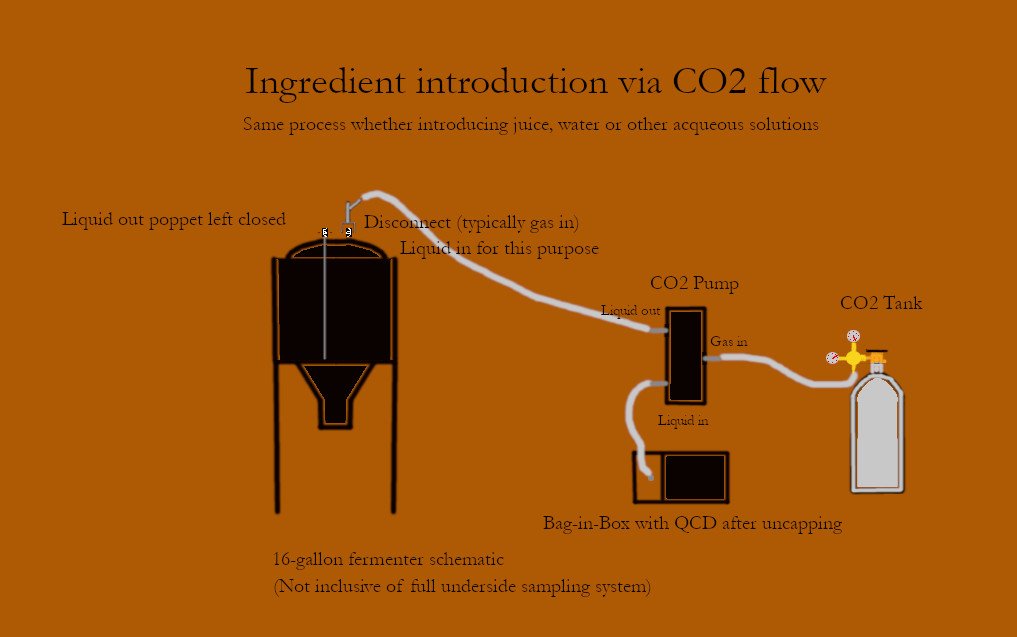
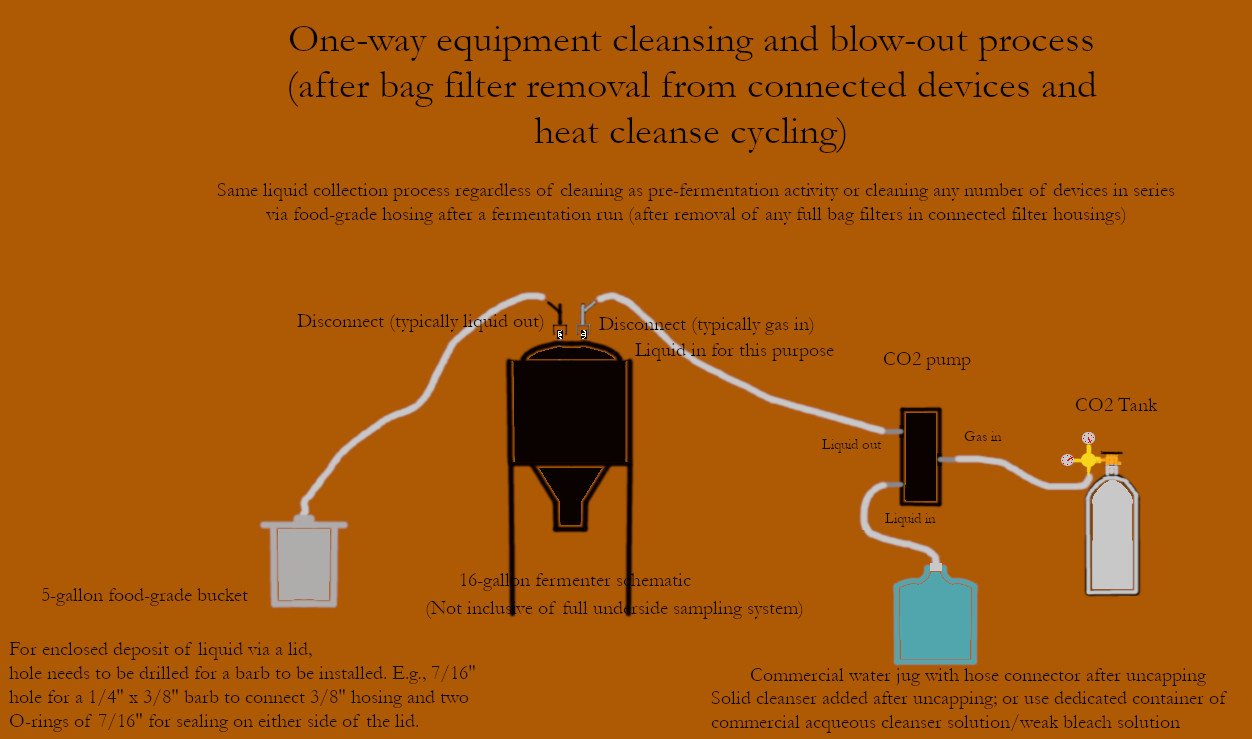
2. To meet FDA and WSDA standards of enclosure (separateness of ingredients from production), all fermenters will be pressurized (covered) before use and filled with sanitized water via CO2 tank action (quick disconnect valve connected to a given fermenter’s input poppet valve; food-grade hosing connected to it and the CO2 tank’s regulator). Downstream, the fermenters’ outgoing poppets and attached disconnect valves are connected to buckets with spouted lids on the downstream side (liquid waste collection from initial cleaning; not acidic so does not necessarily need to be picked up from a waste vendor versus direct sewer disposal but this would generate use of the building’s kitchen space). Pre-packaged materials will be used for actual fermentation runs (e.g., bag-in-box juices; jugs of water) to be introduced into the fermenter systems via QCD connectors or similar parts after an initial sanitization process. A QCD connector being installed for a given ingredient introduction run, in its status as not being part of an enclosed sanitization run, then needs hydrogen peroxide or another chemical sterilizer applied to the lips of the actual input and output components (very small introduction of chemical compared to gallons of ingredients, water or other aqueous solution being pumped within that instance).
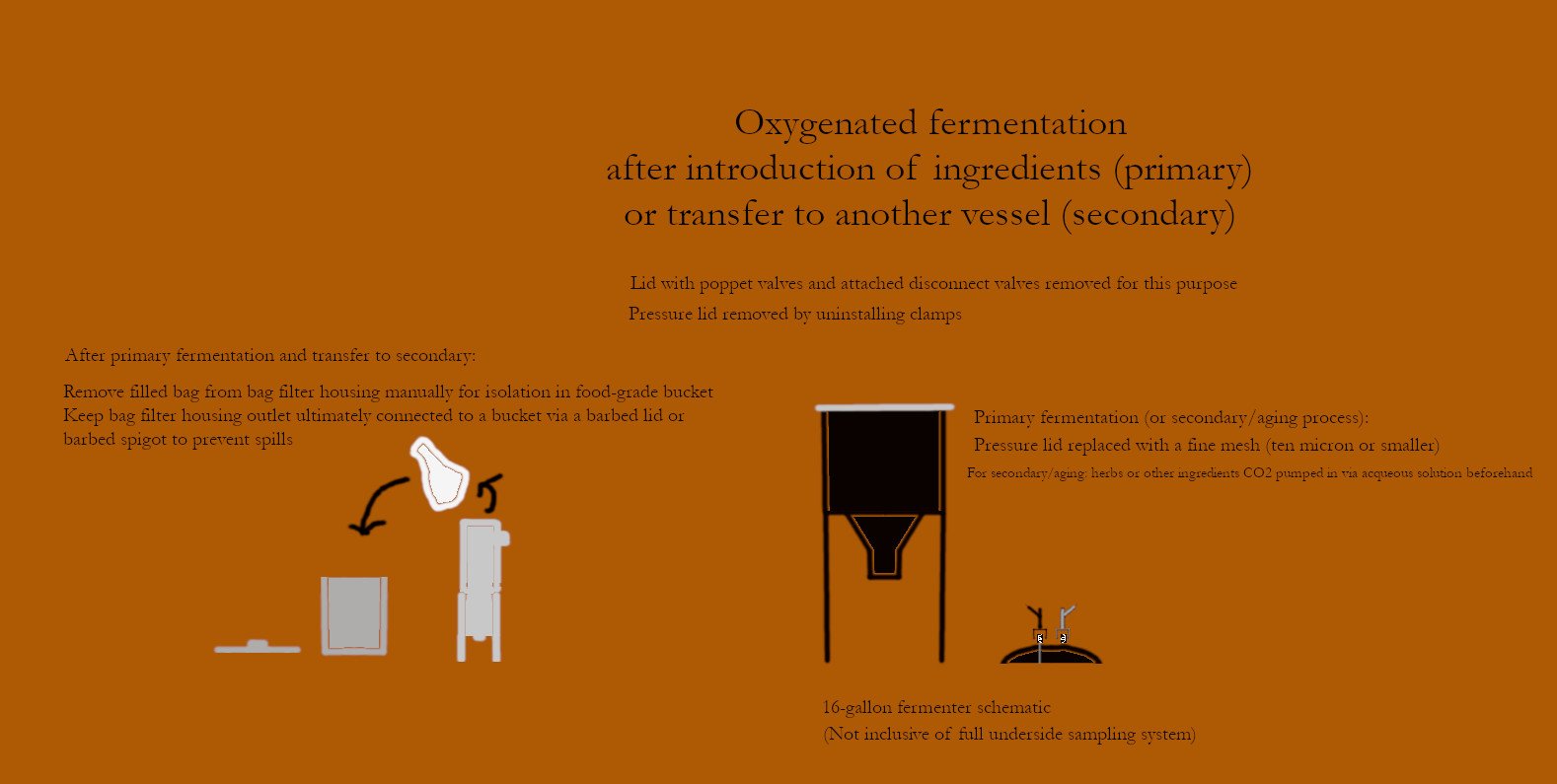
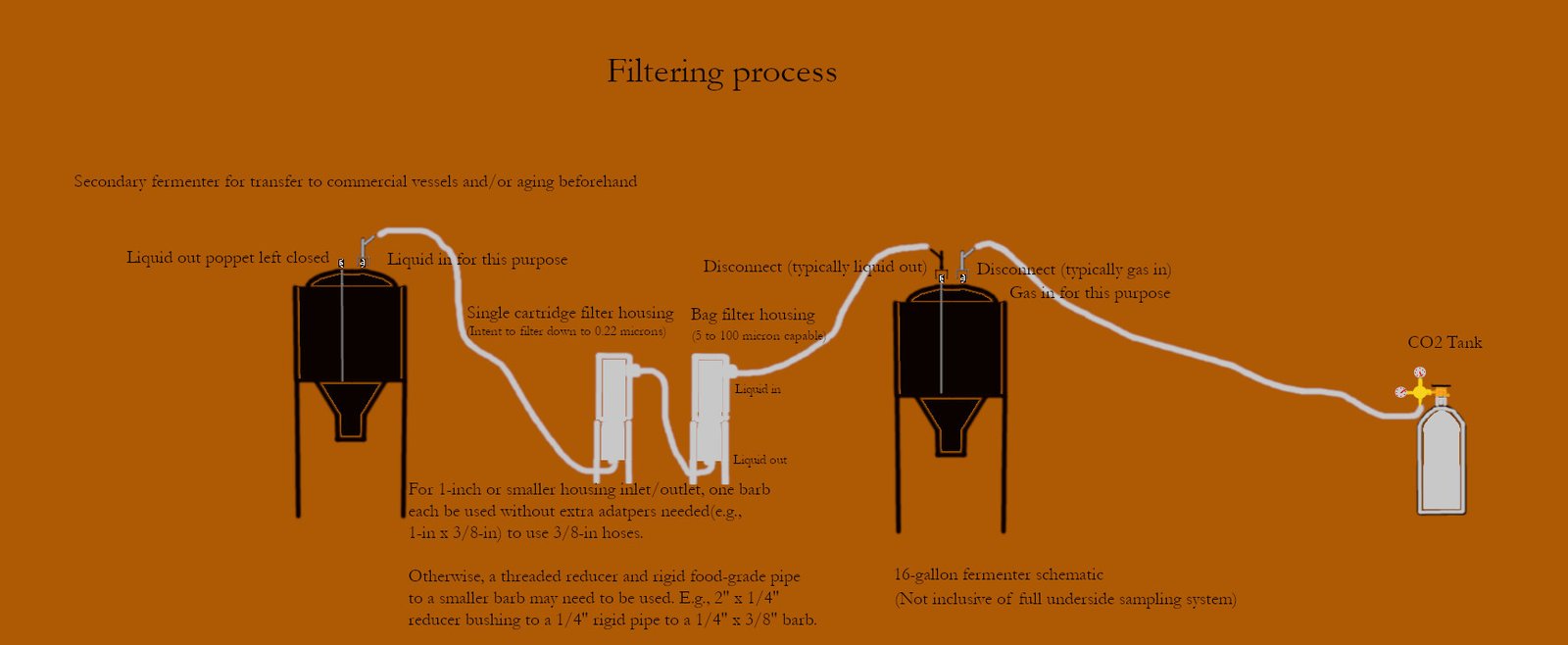
3. Oxygenated fermentation requires reasonable exposure to air which most economically involves the use of mesh covers of a sub-millimeter pore size. That is, the hard pressurized cover would be replaced by a mesh cover (aimed to be ten microns or finer) on the top of each fermenter used in a production run after the enclosed introduction of ingredients. After primary fermentation (determined by auditory queues, refractometric sampling of Brix values and hydrometric sampling of SG values to ensure low sugar and low alcohol), filter housings of a number required for the purposes of a given production run (one bag filter housing for macroscopic waste collection and one cartridge filter housing for 0.22 micron-level waste collection at minimum; full sterile filtration) will be connected in series to each other (if using more than one housing at once) and sanitized beforehand using the aforementioned enclosed process. Afterward, they will then be connected to a fermenter containing a given run’s liquid and to a CO2 tank and regulator system on the upstream side and to an empty collecting fermenter on the downstream side (for final commercial entrapment using a hose-connected can filling machine and/or for aging before canning); then disconnected and switched to another fermenter for the same process after replacement of the bag filter and enclosed sanitation (if more than one finished primary fermentation run is being processed at the same time and if fewer filter housing systems are being used than primary fermenters).
4. Each fermenter used in a given process will be fully covered again using their metal lids (pressurized) and blown through with sanitized water with the final output collected in buckets with spouted lids. The same goes for cleaning filter housings after use and after removal of full bag filters into buckets. Solid waste collection and remaining liquid waste from final enclosed blow-out cleaning into buckets (acidic) would then be picked up by a specialized waste supplier; same as planned for used water collected from initial sanitization procedures.
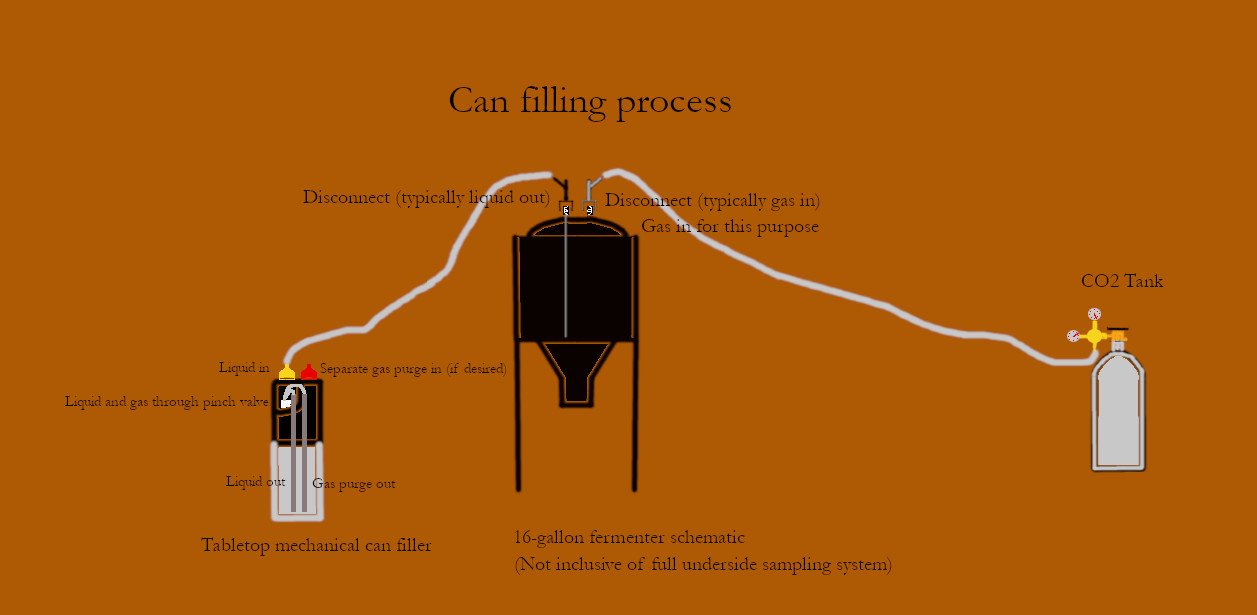
5. 16-gallon fermenters will be used within initial operations in terms of the largest pieces of equipment (about 2.25 square feet each and 3 feet tall; in that sense assuming an operating area of 4 square feet each at most to account for operational spacing from any walls and from other pieces of equipment). Final filtered liquid that is collected into final fermenters/final sealed containers would then be canned or bottled with appropriate machinery or tools for that purpose (for cans, liquid run through a mechanical filling machine to ensure sealed flow; followed by final enclosure with a mechanical double-sealing machine). Filling of final commercial vessels would need to take place via a food-grade hose from a quick disconnect system from CO2 tanks to the final fermenters and then downstream to the can filling machine (pressurized gas flow transport action). Any sort of finishing ingredient additions before final canning/bottling or for sitting in secondary fermentation beforehand would also be introduced via pressurized CO2 from a sanitized enclosed vessel (e.g., herbs in an aqueous solution).
6. The entire point of filling commercial vessels in a production process as described is to prevent the use of wet pasteurization methods and expensive machine-based aseptic filling methods downstream of the “holding tubes” (the fermenters and filtration systems). However, this brings up the possible re-introduction of microbes upon filling. Because sterilizing chemicals such as hydrogen peroxide as a waterless method to sterilize vessels, the nozzle of a filling machine/tool and the interactive components of a sealing machine/tool would present a potential problem in applying without exceeding parts per million maximums (no way to remove the excess in this sort of setup), indirect heat pasteurization in an enclosed manner (or other enclosed pasteurization system) of the sealed vessels has to be conducted (indirect heating of vessels via containerized water and the enclosed filling of the machine via jugs of water, food grade hosing and compatible connector systems). This is the most straightforward method conceived after research.
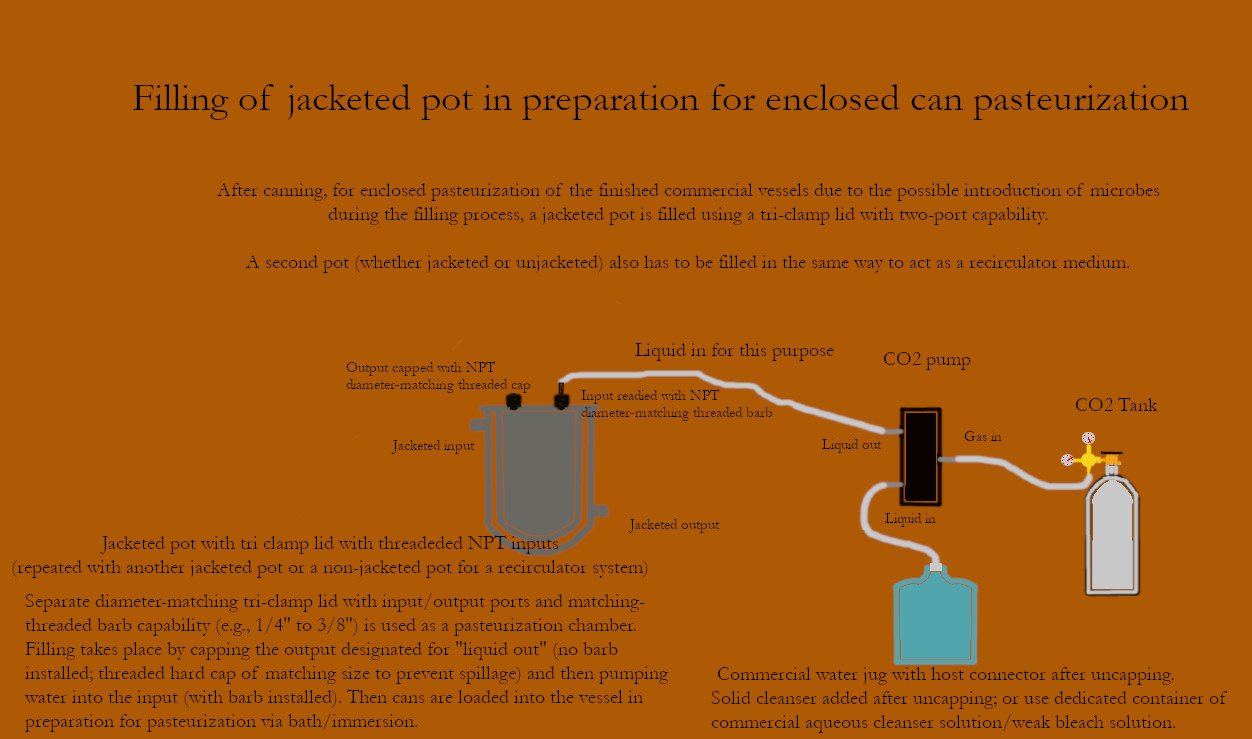
7. In that sense, after the can-filling and seaming process, the next step involves indirect pasteurization which required more thought in order to take place in an enclosed manner. A number of products and systems were considered per the “initial capitalization costs” section of this document. For the scale of initial business activity and budgeting involved, it’s planned for sealed cans to be pasteurized in a bath within a jacketed pot where the main chamber is filled via CO2 pumping from a hose connection with a compatible tri clamp lid acting as the enclosed input/output method (lid with at least two ports capable of taking hose barbs for both the source pot and jacketed pot full of cans; i.e. 1/4” x 3/8” barbs but where the “liquid output” designated port and tubing would be closed off with an NPT size-appropriate end-cap during the filling).
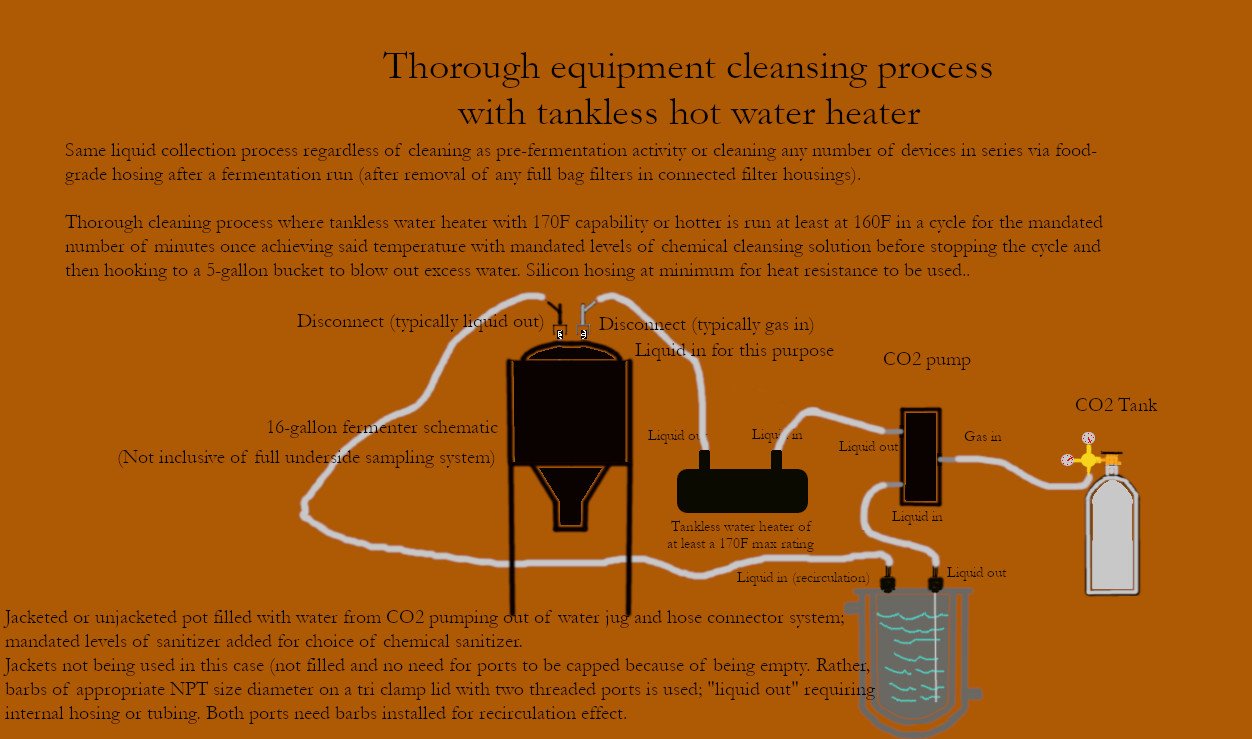
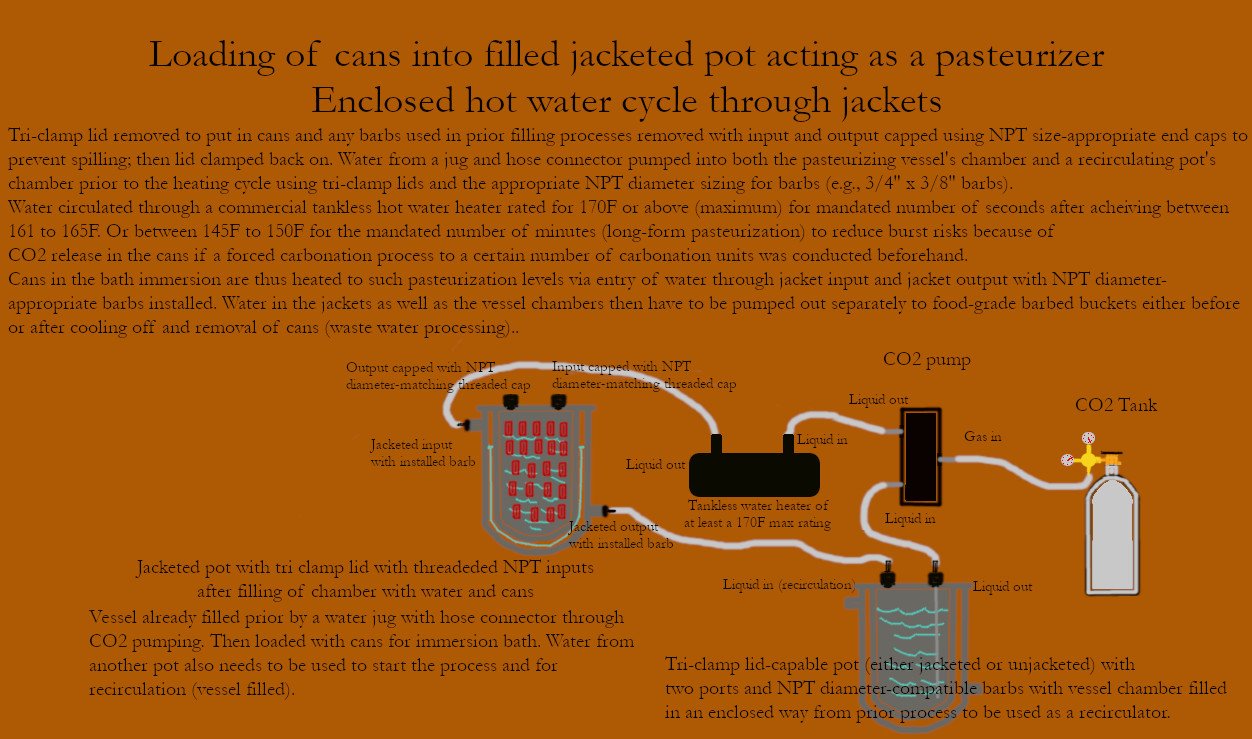
8. Then after loading cans and re-lidding with both ports capped on the jacketed pot’s lid, another pot filled in the same way (whether jacketed or unjacketed for this purpose) and with the same type of lid (both barbs installed and tubed into a circulatory system) will be pumped for water via a CO2 pump and tank through a tankless water heater (rated for 170F or higher). Water then circulates through the jacket input port of the pasteurizing vessel and out the jacket output port (both installed with NPT size-appropriate barbs) to be recirculated back through the lid of the source pot.
9. The initial cycle plan assumes pumping water for a mandated number of seconds after achieving a temperature of at least 161F; or at least 145F for a mandated number of minutes (long-form pasteurization in the latter scenario if there are concerns of burst risks at an estimated number of dissolved carbonation units from a forced carbonation process); and using allowable cleansing chemicals at allowable concentrations in the mix. This is presumed to be what a process authority would recommend (temperatures akin to juice or milk where a process authority could help determine the exact hold times and where the FDA indicates 15 seconds and thirty minutes, respectively, for milk in particular). The company would get the services of a university’s food science program or other type of reviewer to act as the process authority. This is on the assumption that initial product offerings would not necessarily be exempt from Acidified Foods rules given that they do not cleanly fall under soft drinks; more so under functional beverages (filing of Process Authority Letter and FDA 2541).
10. Used water from vessel chambers and jackets then needs to be pumped out to barbed waste buckets either before or after sufficient cool-down and removal of cans following the indirect pasteurization process. Flushing water before can removal would allow a chance for the cans to ambiently cool down faster to prevent an impact on taste; or a second round of cool water may be prepared in a source pot and cycled without the water heater in the device loop.
11. All other devices can be thoroughly internally cleansed at heat in the same way before a fermentation run or after a racking process (fermented liquid transfer) following removal of any full bag filters. Then the more basic process of running a final batch of water through the system to a barbed bucket can take place as a finisher as described before; where CO2 could be run for a certain number of minutes to ensure dryness in the devices.
12. Bag filters filled with captured solid waste need to be carefully removed by hand and emptied into a waste bucket as an exception to completely enclosed processing. The same applies to carefully removing any large woodchip pieces (such as applewood) if larger pieces than shavings in aqueous solution are used in an aging process within a fermenter as part of a secondary or tertiary fermentation process before final canning or bottling (unlikely to blow out in CO2 transport through food-grade hosing because of size).
13. For these reasons (enclosed production, ingredient transport and equipment cleaning), the company does not anticipate needing to use sloped floors with pH-neutralizing drain systems to meet good manufacturing practices (no mass washdowns or other open flows of liquid) which is what primarily went into commercial/industrial site selection and negotiation considerations. Risk of spills can be accommodated by using C-clamps across all food-grade hose connections (barbed hose connectors) and placing drip pans under each connection; and employing a commercial mop for any spills that do occur. This also accounts for ensuring a sanitary pattern of ingredient receipt, storage and preparation (enclosed mixing in this context) which is a concern of King County for Type II beverage businesses (no “taproom” planned (no on-site consumption or off-site takeout) but sales would take place to other businesses or through direct-to-consumer shipments).
14. Pre-packaged ingredients of the kind described would be planned to be used quickly upon delivery (no planned refrigeration needs). The most likely perishable content in use would be fruit purees or other juices which only require refrigeration (severe decline in shelf life) after unsealing bag-in-box caps. Ongoingly used dry ingredients such as bottles of herbs or bags of woodchips would be kept in boxes.
15. Re-use of live cultures used in a fermentation run is one method of saving costs and allowing for continual efficiency via culture adaptations within ongoing similar fermentation conditions across runs of similar compositions. For that reason, after primary fermentation in a given run, the company would find it worthwhile to take an unfiltered liquid sample in such circumstances via a food-grade hose and disconnect valve system with a CO2 tank to push into another sealed sanitized vessel (such as a keg) partly filled with sugary water and possibly yeast/bacteria nutrient formulas. Afterward, the keg would need to be opened and covered with mesh of a sub-millimeter pore standard to allow a symbiotic bacteria and yeast culture to breath until pressurized introduction into an intended fermentable base (replacement of mesh with the pressurized lid at that point).
16. Initial product offerings are not necessarily planned to be carbonated, but if they were then it would be expected that a final filtered liquid from a fermentation run would need to sit in an enclosed fermenter (secondary or tertiary aging) at a maximum possibility of 26 to 31 PSI for several days (when keeping a tank and regulator attached at the same equilibrium setting used to achieve such a target pressure) to achieve 2.5 carbonation units (within range for a fruit soda) at an expected climate-controlled room temperature (65F to 70F) before release into commercial vessels [American Society of Brewing Chemists chart for estimated beer CO2 absorption as a nearest product equivalent with absorption data]. A CO2 tank and regulator attached to the containing fermenter’s “liquid out” poppet valve (via a disconnect valve) would need to introduce gas while a spunding valve, gauge and disconnect valve system attached to the “gas in” poppet valve (the valve without a tube attached to prevent gas from carrying liquid out) would need to be adjusted for spunding valve tension until achieving the target PSI at a setting just short of allowing gas to escape. This requires a gauge capable of measuring up to 60 PSI to achieve an accurate and steady setting in a safe manner, and all pressure would need to be released prior to the commercial vessel-filling process (canning or bottling).
17. If forced carbonation is in fact executed in the company’s process, on practical review, 2 carbonation units or less per can would be considered in terms of realistic possibilities given the extreme pressures that an aluminum can might encounter during standard pasteurization (145F temperature range) if carbonated much beyond that level (risk of bursting). The company has to conduct pasteurization after bottling given that the process has to be enclosed and that expensive aseptic bottling machine solutions aren’t being considered (especially because of the small starting space conditions) which leaves an actual risk of bursting if carbonation is taken too far. 2 carbonation units at typical climate-controlled room temperature levels would be expected to take place in a few days at between 19 to 21 PSI and 1.5 carbonation units would be expected at between 10 to 13 PSI (the lower end for most carbonated beverages).
18. Even though the company will, at least for initial products, pursue oxygenated fermentation with sub-millimeter cover-mediated exposure only, it will be aimed to have a one-gallon headspace in each filled fermenter to prevent the possibility of overflow. This is unlikely to occur anyway in the subdued carbon dioxide-releasing environment of symbiotic cultures, but in sealed fermentation using a spunding valve for gas release and using a fermenting material with low-viscosity liquid/semi-solid mixture (e.g., puree that has not been diluted with water to any lower level than 60% or so), carbon dioxide production in the matrix can sputter the low-viscosity material out of the spunding valve until sufficient space is relieved (via the typical “gas in” poppet using a disconnect; not via “liquid out” due to connection to a liquid release tube). Otherwise, the spunding valve could be connected by hose in such circumstances to a keg for recapture of any material that happens to sputter out or to a barbed bucket as waste capture.
III. INITIAL PRODUCTION SPACE PLAN; RELATION TO MEETING U.S. FEDERAL AND RELEVANT LOCAL MANUFACTURING STANDARDS IN FOOD PRODUCTION
1. Christopher Stephen Clayon has secured initial space at DDDD (a commissary kitchen share) willing to keep the permanent fixtures of equipment on site in a “workshop” area (of the same flooring variety as the kitchen area (heat and chemical resistant), but without a drain or explicit ventilation system immediately in the vicinity such as a Type 1 hood). The kitchen area’s floor drain does not have assured pH neutralization capability before outlet into the sewer system; hence the plan to collect waste in an enclosed manner for waste service pickup. The company would take over the lease from Christopher upon formal formation.
2. Food prep is not initially planned, but if certain ingredients were to be prepared beyond the stated initial manner of enclosed mixing (mashing and heating for additional complex sugar breakdown with the aid of a Type 1 hood system and three-sink system), the actual commissary kitchen area of the building is not anticipated to be used more than twice per month for such a purpose under the company’s initial small-scale plans (assuming two-week fermentation cycles or so). Christopher Stephen Clayton has an active King County food worker license and anyone else onboarded into the company fulfilling a food preparer role in this sense (either in whole or in part within comparative job functions) would also obtain one.
3. In this sense, the anticipated amount of starting equipment (no more than six sixteen-gallon fermenters in terms of the largest pieces of equipment) is not anticipated to overload the floor of the workshop space in any manner. At absolute most, the fermenters may collectively produce 1,200 mL/min of CO2 upon research of what a 16-gallon fermenter is expected to produce at absolute peak during a two-week or so primary fermentation process (200 mL/min) and assumes no liquid absorption of CO2 from entrapment by acetobacter pellicle material. This type of output would take hours to overwhelm a 1,000 square foot space to the level of OSHA’s limitation of 5,000 parts per million (assuming an initial air quality of 400 parts per million of CO2) if there was absolutely no ventilation.
4. Because boxed ingredients as well as the fermentation process itself are separately enclosed from each other, there is no apparent anticipated need for a free-standing steel post and rail system for food-grade plastic curtains to enclose off the entire partition from the rest of the workshop space within this small-scale production scenario. However, for absolute segregation and safety, the proposed area to be taken up in the workshop area for fermentation and enclosed mixing purposes could be surrounded by such a system alongside an extra internal curtain partition to separate out an ingredient storage area. Regardless, any stored ingredients would be in their own enclosed containers/boxes as well.
5. Proposed initial production address as initially secured by Christopher Stephen Clayton pending LLC corporate formation:
D
D
D
D
6. Site layout with proposed initial production space to be taken by the company’s initial permanent fermentation operations (xxxx sq ft):
IV. COMPETITOR ANALYSIS; RISKS; STRENGTHS, WEAKNESSES, OPPORTUNITIES, THREATS
1. Two examples of nearest competitors in Washington State making similar products have been primarily considered which have high-ranking placement in Google search results (non-alcoholic fermented products; CommuniTea and Seattle Kombucha Company). These businesses, however, either add sugar or cut fermentation short to retain natural sugar in their products. The goal of the company in contrast is to create products where non-alcoholic fermentation is allowed to complete down to a level of nearly no sugar as well as nearly no alcohol while keeping acidic (vinegary) taste within subjectively pleasant levels (low sugar fermentation to begin with) for balance between the organic flavors produced from fermentation; or to add additional post-fermentation flavorings or acid regulators for re-balancing. The company also plans sterile filtration in its processes (no probiotic element where the FDA has not found the existence of proven health benefits).
2. Rachel’s Ginger Beer and Seattle Soda Co. focus on non-fermented soda drinks. They take up a general share of the local drinks market but would not be competing in anything akin to the same category as the company.
3. It’s generally known that alcoholic drink consumption has declined, at least among younger drinkers. Flavored seltzers in particular have become a growing category which the company finds its initial product offerings generally overlaps with in a similar manner as kombucha/kefir-like products.
4. Multiple sources cite kombucha or kombucha-like products as an industry in the low billions of dollars of U.S. market cap annually [Grand View Research, https://www.grandviewresearch.com/industry-analysis/us-kombucha-market-report; Good Culture, https://www.goodcultureingredients.com/blog/the-american-kombucha-market-in-2023-big-challenges-amp-bigger-opportunities]. Taste curiosity is cited (not even necessarily probiotics/health curiosity which is not the concentration of the proposed company anyway apart from low natural sugar); but taste can also be a problem of convincing consumers to give such products a try (vinegary). This is where the company aims to add additional flavors via aging in herbal form (namely, consideration of allspice and cinnamon; vanilla extract in levels sufficient to balance acetic acid flavor and the brightest fruity flavors) and/or wood shavings (namely, consideration of applewood) alongside starting with low concentrations of sugar to begin with to result in mild acetic acid flavoring in the final fermented product.
5. Alongside engaging in sterile filtration (no possible probiotic effect from active culture and no plans for any sort of “probiotic/prebiotic” marketing), the company’s flavor and ingredient composition strategy is aiming for a product somewhere between kombucha (oxygenated fermentation for the production of additional compounds) and functional sodas (not fermented but makes use of other bases besides tea and can also claim prebiotic/probiotic benefits in their marketing in the same way (given appropriate notice of lack of FDA endorsement) because of ingredients such as “prebiotic fibers”). Large players (namely, Coca Cola and Pepsi) are now entering the functional soda space as defined in this way (albeit still with noticeable sugar contents; at least in Pepsi’s plans for 5g of sugar per can) and it can also be considered to have an annual U.S. market cap in the low billions of dollars [TheStreet, https://www.thestreet.com/retail/coca-cola-adds-a-healthy-version-of-coke-and-sprite).
6. Good Culture in particular cites price sensitivity past the retail $3 USD per bottle mark (where $4.00 to $5.00 may be considered to be “premium”) where $2 to $3 tends to spark the most sales potential; but this was in reference to the most aggregate growth occurring in the U.S. Midwest. Achieving such low prices on the U.S. West Coast relative to production costs (primarily packaging and rent) may be a challenge but would represent absolute competitiveness on price, where Seattle Kombucha Company and CommuniTea tend to sell ~450mL size bottles in the $4 to $6 range upon research.
7. The company is starting off as a small production space with no brand awareness among the starting local target population (generally, adults in the greater Seattle area) with subsequent reliance upon finding wholesale buyers or direct-to-consumer opportunities (no public-facing taproom or other physical public-facing space). That means initial reliance upon online marketing or aggressive in-person marketing. Christopher Stephen Clayton brings ten years of work experience in finished goods supply chains, six years in home brewing and knowledge in building websites from scratch but has not worked intimately in marketing (limited experience in Google Ads and graphic design; nothing that has commanded relatively high levels of attention).
8. There’s nothing about the company’s initial planned products that cannot be replicated by other persons or entities in terms of industry risk in the space unless specific formulas were trademarked and/or patented at either or all of the WA State and Federal levels.
9. At the small initial starting scale of the company, finding space within which to start out on Christopher Stephen Clayton’s part was not straightforward for the proposed use case. Warehouses in theory make the most sense for these types of operations (passive sitting of containerized fluids) but that proposition was continually denied by both individual warehouses in the greater Seattle area and large national-scale warehouse space share schemes with partitions in the region (he contacted at least three major national chains). Small commercial kitchens also sometimes have expensive software-oriented models that increase the effective price per square foot (he contacted a national chain of that variety regarding one of their buildings in the region, but did not see a way to use such features compared to the price). Two other individual small commercial kitchen spaces never contacted him back in SoDo and downtown Seattle. However, a small initial space within a commissary kitchen environment in SoDo was secured as described. If the company does experience growth, it may then be easier to find larger kitchen spaces to expand into or to consider taking a full taphouse space with an attached brewery.
10. If the company were to grow beyond the initial planned maximum capacity within the initially planned and secured space (six 16-gallon fermenters; 365 liters or 1,028-unit aluminum cans (355mL each) worth of production at planned maximum on a two-week or one-month basis assuming a process only involving primary fermentation), growth into 155-gallon fermenter equipment pieces and subsequent space expansion would entail renewed analysis of site selection, floor loading concerns, ventilation concerns and clean-up strategy analysis. The original location would be considered for retention as a small-scale experimental space in such a scenario.
11. The U.S. Alcohol and Tobacco Tax and Trade Bureau would become interested in any production phase resulting in any liquid containing more than 0.5% alcohol by volume; including any such occurrences after canning/bottling from leftover fermentation (triggering the relevancy of other Federal requirements on top of FDA site approval, adherence to manufacturing standards, descending ingredient listings on labels, etc.)
12. In Christopher’s testing of an initial 4.5-gallon fermentation (peach puree of 1.06 starting SG (specific gravity) composed of all-natural sugar reduced down to 1.01 SG with water and wet starter culture) and letting the sugars ferment down as much as possible, this resulted in a final value of 1.001 SG on a hydrometer (0.26 degrees Brix) and a 1.006 apparent refractometer SG (apparent 1.5 degrees Brix); meaning around a 0.27% calculated alcohol by volume level using a nearest-equivalent equation from sake production (reconciliation between hydrometer and refractometer values because of generated organic compounds; [Home Brew Sake, https://homebrewsake.com/measuring-your-sake-%E2%80%93-part-two-percent-alcohol-by-volume/?doing_wp_cron=1791163260.7010369300842285156250].
13. The peach puree experiment also resulted in the lightly acetic general flavor desired (ability to add flavors via spices or woodchips as part of any aging processes) without an extremely low acid value (3.26 final pH as measured electronically from a starting electronic value of 3.4 pH before fermentation in a mixture consisting of 22% peach puree, water and wet starter culture).
14. Because the company is not concerned with probiotics (sterile filtration as a means of mechanical pasteurization after fermentation) and will use symbiotic cultures as the fermentation engine (ethanol production more or less immediately converted into acetic acid), there is no appreciable risk of initial planned products and any product developments within the foreseeably-planned scope falling under post-production scrutiny for alcohol content.
15. Ongoing initial liabilities include payment of rent on the starting production space, the ability to retain the space and the funding of ad campaigns as necessary to help create brand awareness with initial reliance on capitalization from Christopher Stephen Clayton to cover such expenses and investments at first. Starting equipment (capital goods) will be purchased outright using liquid capital contributed by Christopher. He has also explored supplier sources for necessary ingredients, albeit not at wholesale relationship levels starting at small scale (the most important being fruit purees delivered as bag-in-box systems without seasonality bottlenecks [e.g., from Fierce Fruit] and initial cultures in either dry or wet form [e.g., White Labs; Fermentaholics]). Further, Christopher created an initial break-even analysis on basic ongoing expenses (sales necessary at an initial planned price point per can to meet rental obligations). There are local options for the filling of CO2 tanks at a small scale and at negligible cost (anticipated initial use of one or several 5-pound CO2 tanks with regulators; [e.g., able to be serviced by AAA Fire Protection in the Fremont neighborhood for tanks with cylinder heads meeting their pressure safety standards]).
16. Dry yeast starting cultures in 10-gram pouches tend to be recommended for five-gallon batches, dry single-varietal bacterial cultures tend to be in larger pouches with recommendations of amount to use from the pouch given on a five-gallon basis and mixed symbiotic wet cultures tend to be recommended for 1-gallon batches. This industry trend is in part intended to ensure that only a desired culture takes over a fermentation base. Wild yeast population formation (Kahm yeast) is a common possibility in oxygenated brewing with some flavor contributions (particularly on after-taste) if it forms and is not significantly out-competed. Non-food grade mold formation (aflatoxin risk) in particular is a health risk in oxygenated brewing, but using ten-micron or smaller pore-width meshes over fermenter vessels should mitigate the chance for formation. Such covers are also for preventing the input of insect materials beyond what’s already within ingredient inputs (pest control and general odor control).
17. Wet symbiotic starting cultures and dry bacterial cultures tend to be more expensive than individual dry yeast cultures (see variable costs section). A mix of capturing liquid after primary fermentation on a particular run before filtration for use on subsequent primary runs (enclosed capture followed by using a fine mesh cover for oxygenation until used as an ingredient) alongside some supplementation from commercial dry cultures would allow for reasonably ensuring intended cultures take over a fermentation base without the expense of solely using commercial wet cultures at recommended levels on every single primary run. Re-introduced culture also allows retention of adaptations specific to the fermentation setup’s conditions and typical fermentable ingredients (e.g., more effective fermentation upon subsequent runs).
V. GOVERNANCE AT HIGH LEVEL
1. The company shall be a C-Corp in terms of U.S. legal incorporation to keep corporate income entirely separate from other persons receiving individual income distributions (reduce risk of alter ego) with a Board of Directors assigned to meet the standards of such a business in its interfacing with government (starting with Christopher Clayton as the sole initial owner-operator). It will have business registrations in Washington State (UBI # …) and in each city of WA State operation (initial registration in Seattle via license # ….).
2. Otherwise, in corporate internal structuring, the company shall operate as a worker cooperative as defined in detail by types of policy and operational standards in a company-level corporate governance/bylaws document whose initial details will be Christopher Stephen Clayton acting as initial sole owner-operator and subsequently subject to changes by collective democratic company-wide vote on an initially-determined voting cadence as soon as any further worker-owners are onboarded to the company. Each person working for the company, regardless of comparative advantage contributed (job assignment; hierarchical level) and level of competency displayed shall then be a worker-owner by contractual definition.
3. This organizational principle is declared as contractually unchangeable (unable to be transformed into another form of organization in terms of core ownership principles under any circumstances) even if a combination of worker-owner shares and third-party investment shares totaling over 50% were to be acquired by a person or entity looking to make such a change.
4. This means each worker/employee (defined as a “worker-owner” after their onboarding and receipt of shares) in the company must retain an equal share of 51% of the company’s shares deemed to be “worker-owner shares.” The exact number of initial shares per the Articles of Incorporation has been set by Christopher Stephen Clayton at 1,020 worker-owner shares and 980 investor shares that are also purchasable by worker-owners with an initial declared total valuation of about $10,000 USD based on planned initial equipment and liquid capital contributions on his part, but further dilution into more shares could be decided by collective democratic vote as the company expands and as the estimated total valuation changes (including changes in how the company’s declared valuation is determined on a private level; so long as there is never a type of investment class share that ever goes public for valuation to take place via order volume patterns as calculated through a digital stock market listing).
5. Each worker-owner must by virtue of this contractual declaration and fundamental ownership principle be compensated base equally regardless of comparative advantage being contributed to the company and level of competency displayed (job role fulfilled in terms of technical/managerial/etc. skills and experience contributed). Corporate governance details on how intellectual property ownership should be shared between an inventing worker-owner and the company entity itself upon the creation of any such property or other forms of merit-based compensation are other matters to be determined in the initial corporate governance document and are potentially changeable via collective democratic vote as any other operating detail.
6. Other decisions decided to be a matter of company-wide integrity will also be changeable/updateable in their details via a company-wide vote (direct democracy). Exactly which types of decisions are subject to collective democratic importance at a company-wide level versus department-wide, job-specific or other type of scale shall be defined in the detailed corporate governance document. The scale of importance of a type of decision can also in itself be changed by a proposal for a collective democratic vote on the issue as part of a given upcoming voting cycle.
7. The company anticipates that matters such as protocols for how much corporate profit and/or treasury should be distributed to worker-owners (the vehicle of compensation rather than wages/salaries as expense events) and under what circumstances; as well as how worker-owner shares would be re-divided and paid out (equity) upon a workforce reshuffling due to hiring/firing/layoffs (such as newly-ownerless shares being redistributed on a particular cycle to allow for financial processing), would remain fundamental company-wide collective democratic concerns.
8. Types of decisions expected to fall under the category of a department-wide democratic decision would be periodic peer review of fellow worker-owners for competence in each person’s fulfillment of various comparative advantages for creating recommendations to the overall company regarding workforce reductions. However, as a worker cooperative ownership structure, the company anticipates retention of worker-owners in whatever way possible even in revenue-lean scenarios; and that people would not necessarily be rigidly assigned to fulfilling only one or a few types of comparative advantages (potential job rotation systems). In this particular circumstance, the final decisions would still need to take place by company-wide collective democratic vote in the same way as actions on recruitment recommendations given the consequence of stripping or purchasing back of worker-owner shares in such circumstances. Any terminations of worker-owners would not impact any investor-class shares they may own (not tied to worker-owner status in the company).
9. If the company were to reach a certain size and subsequently undergo a collective decision to greatly reduce itself rather than for all worker-owners to take relatively low incomes, any such plans and their timelines would abide by State and city thresholds for when reports or notices need to be issued.
10. The frequency of when proposals might be considered for collective democratic voting at a company-wide scale would be a detail decided initially in a company-wide corporate governance document for all current company-wide policies. It may in itself then be changed via a collective democratic vote if there is a proposal that makes it into the next planned company-wide vote session. IT system management and any construction/programming as such would be an example of an anticipated job-level decision process.
11. It is anticipated that should the company grow to have a presence in other US States or countries that the subsidiaries would need to follow the same organizational principles in their own Articles of Incorporation, Business Plan, internal corporate governance documents/bylaws and/or equivalent regionally-appropriate documents as a contractual requirement to take on the company’s branding. Any final decisions on special regional brandings in parallel, regional products, operational decisions, finances, etc. would otherwise belong with the subsidiaries as a matter of corporate separateness within each such business’s market conditions. However, it is anticipated that coordination of general global strategies in branding and other select concerns may take place via collective vote across all global worker-owners as a potential special meeting and voting protocol in the headquarters’ corporate governance document.
VI. COMPARISON OF EQUIPMENT FUNCTIONS AND COSTS FOR INITIAL CAPITAL EQUIPMENT INVESTMENT CONSIDERATIONS
1. 16-gallon fermenters – Initially starting out, minimally needing three (two for primary fermentation and at least one for secondary or tertiary aging and final commercial vessel transfer); possibility for up to six in relation to current plans and current space; around $300 each [e.g., Vevor 16-gallon all-in-one stainless steel conical]. Ten-micron meshes/bags or finer would also be needed to cover the fermenter tops for oxygenated fermentation to prevent the ability for airborne microbes/spores to land in numbers able to be compete with intended cultures (after enclosed sanitation and introduction of liquid, cultures and other aqueous ingredients using each unit’s solid pressure cover).
2. Sub-millimeter sheet coverings - Because the proposed process involves oxygenated fermentation, after introduction of ingredients to a vessel or transfer of a primary fermentation to a secondary fermenter (for any aging processes), the hard lid will be removed and replaced with breathable sheeting. The planning process has found that 10 micrometers act as a pore size to reasonably keep airborne microbes and spores out while intended cultures take over a given medium, but different thicknesses and material types have to be considered as part of costing as well as how much sheeting is actually provided per unit of purchase. A 16-gallon fermenter takes up between 2 sq ft to 3 sq ft of physical space so the openings should be taken as amounting to that type of area (square-cut sheets fitting around a diameter). Thin felt sheeting then provides the most useable material per purchasing unit for reasonable expenditure in this pore size range [e.g., “Polypropylene Felt Filter Felt Sheet - 10 Micron - 0.080" Thick x 72" Wide x 5 ft. Long” from FixSupply.com in the $50 range and “1 Meter Sheet of Polyester Filter Media, 1.7 Meter Width, 1 Meter Length, 67" Width, 39.3" length, 10 Micron” from DudaDiesel.com in the $15 range].
3. At least one bag filter housing is needed in initial operations to collect solid waste in an enclosed manner after primary fermentation along the way to a second vessel via CO2 blow-through when connected in series via hose to a CO2 tank and originating fermenter upstream and downstream to a final holding vessel (e.g., another fermenter). Various examples in the $200 to $1,200 range [e.g., PRMFiltration PRM #4 304 free-standing example in the $800 range using 2-inch NPT inlet/outlet; ideally where a housing with a smaller diameter inlet/outlet would be used for this business’ purpose]. A 10-piece set of bags at PRMFiltration is in the $40 range (5 microns to 100 microns).
4. At least one cartridge filter housing (single cartridge capacity) is needed for filtering down to the 0.45-micron level (bacteria filtering) and 0.2 micron level (yeast) at various stages or all at once depending on level of filtration desired at a given point in a fermentation run (either chained via hose immediately after a bag filter to a target fermenter or in a stand-alone process between two fermenters) ; where final readiness for commercial vessel filling entails sterile filtration down to the 0.22 micron level [e.g., neoPure Commercial Housing Single Filter 2.5" x 10" 316SS using 3/4-in NPT inlet/outlet in the $215 range; not free-standing]. Both grades of cartridges needed for this business’ purposes (or 0.22 micron alone) can range from $40 to $120 [e.g., NeoPure PES 9-3/4" Water Grade Membrane 0.2 Micron in the $100 range and Neo-Pure 10" High Purity PP 0.45 Micron in the $90 range]. Ultimate choice of cartridge housing and cartridges also requires a check for fit (inner diameter of the housing versus the total diameter of the cartridges).
5. Assuming use of cans as final commercial vessels, equipment for filling and double-seaming is needed (bottling not preferred because of the larger shipping cost and fragility of glass bottles; price per empty bottle can also sometimes be more expensive than cans depending on volume purchased at once). A small workbench example can be $250 to $1,000 or more depending on level of automation [e.g., Cannular Pro Bench Top Can Seamer semi-automatic at MoreBeer.com in the $750 range]. The matter of filling cans with a tight enough seal and CO2 purging beforehand is solved with a can filling machine; even more immediate examples in the $1,000+ range compared to sealing machines depending on level of automation [e.g., Cannular Can and Bottle Filler in the $200 range or MB Orthos Dual Head Can Filler in the $700 range at MoreBeer.com].
6. Jacketed tabletop pasteurizers - There are various indirect heating tabletop devices (water stored and electrically heated in the walls of a metal device), but they assume the introduction of uncontained liquid into the system (not filled containers). However, they could be adapted from largely milk-based purposes to the company’s small-scale purposes through the filling of water into the device walls and into the vessel space via the corresponding hose inputs, then opened to introduce filled liquid vessels (immersion) and closed again to start the indirect pasteurization cycle [e.g., “Small Milk Pasteurizer and Yogurt Machine Milky FJ 15 (115V)” from MilkyDay.com in the $820 range]. This particular model, however, only has a means for the enclosed inlet and outlet of water; not for the liquid in the vessel (no inlet for the fluid product medium; let alone an inlet but is considered to be water-jacketed). Similar devices on the market also appear to only have two inlet and outlet ports only for the heating medium (wall spacing) [various Google Shopping results].
7. Any tabletop pasteurizer device for the company’s purposes then needs to be paired with a metal lid of the same or similar diameter for clamping on; such as two poppet valves or other 3/8-inch capable ports where a food-grade hose or pipe would need to be attached to the internal-facing side of one of them to act as “liquid out.” The closest match would be tri-clamp lids in brewing where a spunding valve and gauge would need to be installed into one of the ports’ external interfaces during use (after introduction of immersion liquid to be heated) to track pressure in a similar way as pre-installed pasteurizer lid gauges [e.g., “Tri Clamp 6 in. x 1.5 in. - SS304 w/ (2) Top / Bottom JIC 3/8 in. Ports” from Glacier Tanks in the $190 range]. The problem however is finding a match in diameters between a pasteurizer opening and a lid; where tri clamp lids of the variety sought (two input/output ports) only go up to 12 inches maximum (12.57-inch final outer diameters). Tabletop pasteurizers found through Google Shopping tend to only list product dimensions, if even that much information (no precise opening size details where the previously-mentioned Milky Day pasteurizer example is 12.6-in x 12.6-in regarding product dimensions with a smaller lid in the visuals, but no exact lid details). This brings into question how standardized that lid sizes are within this product space to customize the units into true complete enclosure; but the jacketed porting, heating electronics and small scale are otherwise what the company needs.
8. Jacketed boilers - This then leads to considering jacketed Bain Marie tri clamp boilers as a means of introducing water as an indirect heating source while filling the chamber separately using an alternate tri clamp lid with water to be heated alongside the containerized products to be pasteurized (alternate use compared to bringing input liquids to boiling temperature to produce specific pasteurized liquid products). This again depends if the clamp lids allow introduction and output of the non-jacketed liquid in an enclosed manner; and the tri clamp sizing tends to refer to port size in inches rather than to lid diameter as seen in relatively small tank scenarios. However, there are relatively small freestanding options with 2-inch to 4-inch lid diameters to then allow attachment of same-sized tri clamp lids with alternate ports that meet the company’s needs [e.g., “Jacketed Bain Marie Style Boiler - Copper Liner - 13 gallon” (50L) from Olympic Distillers in the $1,300 range]. There are also even smaller tabletop options [e.g., “8 Gallons Copper Bain-Marie Distilling Boiler Moonshine Still” from Oak Stills in the $1,608 range]. The problem however is narrowness of the systems for attempting to use them with already-containerized liquids, the separate heat source needs (no internal electronics of their own) and the need to step food-grading hosing to potentially very large port sizes (up to eight-inch diameter input/output ports for the jacketing; not the scale of flow the company intends starting out).
9. Boiler pots - Something much simpler (more like a pot with jacket ports) could be considered as well if the opening can match the size range of tri clamp lids that have input/output ports, but there’s still the matter of heat sourcing [e.g., USA Lab 12" Jacketed Collection Base - 1/2" FNPT Jacket in the $290 range]. A tri-clamp lid with inlet and outlet ports that can be barbed or adapted for barbing is still needed to add water to the vessel for the immersion bath and to remove used water afterwards. That means a separate device with its own circulation capability has to be hooked into such a pot’s jacketing to move hot water into it via CO2 pushing or pumping; and the device has to provide a stable temperature read-out to ensure meeting or exceeding pasteurization temperatures. A second jacketed or unjacketed pot with tri-clamp lid capability and use of a second tri-clamped lid with a port then has to be used as a recirculation device after pumping its chamber with water. In that sense, a fermenter with a lid and disconnect valves could act as the circulatory agent (the primary planned piece of equipment).
10. Tankless water heating - The most cost-effective and space-efficient method for a circulatory pasteurization system would be to use a tankless hot water heater with a temperature sensor and maximum capability of 165F+ via its own hook-up to a water source (water-filled jacketed or unjacketed pot with tri-clamp lid and NPT size-appropriate barbing installed) and CO2 pump to run water continuously through it. However, many portable ones max out at 140F in spite of a wide price range of $250 to $1,600+. There are few electric tank-based heaters that reach 165F+ but there is at least one relatively affordable example [e.g., “RHEEM-RUUD Point-of-Use Electric Water Heater: 20 gal” through Grainger in the $1k range but it is much too large for the company’s initial use case; and a tank increases spill or breakdown risks]. There are expensive tankless examples (both gas and electronic) [E.g., “RHEEM-RUUD Point-of-Use Electric Water Heater: 20 gal” in the $2,200 range; Takagi-brand gas-using examples in the $3,000+ range]. There are also less-expensive options; primarily based on sorting all of Grainger.com’s listings for tankless electric heaters; $800 to $1,300 range [e.g., “EEMAX Electric Tankless Water Heater: ProSeries, 240V AC, 27,000 W, 113 A Current, 80°F to 180°F” in the $1,000 rang]. Or in the absolute budget range up to 170F, there are Bosch commercial models in different power consumption grades (all the same flow rate so presumably higher max power consumptions would heat water faster) [e.g., “BOSCH Electric Tankless Water Heater: Tronic 4000 C, 110/120V AC, 3,500 W, 30 A Current” in the $275 range]. A separate temp sensor or thermostat may need to be plugged into these less-expensive devices to get an explicit temperature reading, however. For these purposes after research, a lower-expense electric tankless device, jacketed and ported pot with a separate input/output-capable tri clamp lid, and appropriately-sized threaded hose barbs for each input/output is what the company aims to use initially as its commercial vessel pasteurizer system after the filling of such vessels. Additionally, such a heater could be use in series as part of the entire internal equipment sanitization/equipment process loop as well (pre-use cleansing and after-run cleaning after any bag filters are removed from the device series). This means silicone hosing or even more heat-resistant varieties of hosing have to be used in all in-series flow processes. However, one more post-filling pasteurization method is considered below.
11. Batch (non-jacketed) immersion pasteurizers - A method of indirectly heating finished, filled commercial vessels or via an enclosed immersion has to be conducted as the most straightforward method of ensuring destruction of any introduced microbes at that stage given anticipated difficulties in being able to sterilize or pasteurize liquid in an enclosed, aseptic manner otherwise upon leave from the production system (the “holding tubes”). Any pasteurization method involving open water streams or steam streams in that process would contradict the point of the entire production setup leading to filling and seaming (enclosed production and waste collection without use of a floor drain and sloped floor). Even if not indirectly heated, an immersion system has to be able to be fully enclosed after the loading of vessels. In that sense, there is one example of a relatively small size for an industrial level of capability [“Pasteurizer Machine/pasteurization Line Stainless Steel Pasteurizer” from Zhengzhou Heer Machinery Co., Ltd. on Alibaba.com at $1,200 for a single rectangular device that can be enclosed by a lid; 100L/hr. capacity; 3.9 x 3.3 square feet physical space; 12kw/hr. consumption]. This example is still large for the company’s initial purposes, but is far smaller than tunnel pasteurizer setups costing in the thousands or tens of thousands; including multi-stage conveyer belt systems that aren’t necessarily enclosed. This batch system and another like it in the same cost range from Henan Leiqing Machinery Equipment Co., Ltd. also do not seem to have any inlet or outlet ports for enclosed filling of water. This option is then not being considered by the company at this stage because of a need for absolutely enclosed processing with only small-scale needs.
12. Cornelius keg - 5-gallon thin, enclosed system with poppet valves in the same manner as steel fermenter vessels (for attachment of disconnect valves and hoses). At least one would be needed starting out as a means of introducing sanitized water to fermenters in an enclosed manner (cleaning process) and potentially for pre-mixing ingredients before introduction to a primary fermentation process. $100 to $120 each range [various Amazon.com suppliers; used ones possible to find more cheaply on eBay.com].
13. Cylinder (CO2 tank) with DOT-certified head - At least one needed to start at a 5-pound capacity for the enclosed transport of liquids via CO2 flow; $60 to $120 range [e.g., Vevor CGA320 in the $70 range and otherwise multitudes of options on Amazon.com]. That means a need for regulator valves to pair with each one; $20 to $60 range [multitudes of brands on Amazon.com].
14. CO2 pump - At least one needed to pair with a CO2 tank during the process of extracting fluid from a QCD connector-fitted system or hose connector system (bag-in-box systems; water jugs). This then consists of gas in, liquid in and liquid out ports. Range of $150 to $250 [E.g., Three Pump Kit w/ CO2 Manifold Gray QCD BIB Connector from Bevco in the $250 range].
15. Spunding valves with installable PSI reader capability (at least capable up to 60 PSI) - one for each fermenter as a gas release mechanism without reliance on emergency relief valves; around $30 each [e.g., DuoTight brand through Lion Brewing Solutions or other sellers].
16. Disconnect valves are then necessary parts for connecting food-grade hosing between devices with poppet valves as their intake/outtake systems; around $10 each for both intake (gas) and outtake (liquid) styles where one of each are then necessary for each fermenter and one for each device that may be paired with a fermenter (e.g., pairing between a fermenter and a Cornelius keg) [e.g., Home Brew Ohio LLC].
17. Food-grade buckets - 5-gallon plastic buckets where at least one to two per primary fermenter are needed for terminal collection of waste during a CO2 blow-through cleaning process. $30 to $50 each range [various suppliers on Amazon.com]. Ideally, a contracted waste take-out supplier would return buckets after processing.
18. For the enclosed filling of buckets (hose connections), lids with some sort of a spout or buckets with spigots have to be used where compatibility with given connectors (or the possibility of direct interfacing with a 3/8-inch hose) need to be confirmed for a given brand. Lids with pre-installed spouts are in the range of $6 to $15 each, but aren’t necessarily the correct diameter for receipt of 3/8-inch hoses [e.g., Vestil LID-2-PWST at WebstaurantStore.com]. There are lids with holes already included but they tend to be formatted for airlocks [e.g., “Lid For Bucket (With Hole for #6 Stopper)” at MoreBeer.com in the $6 range]. Buckets with pre-installed side spigots also do not tend to have matching diameters for 3/8-inch; a hole has to be drilled into the side of a bucket of appropriate diameter for a 3/8-inch barbed spigot to be separately installed which are in the $4 to $8 each range [e.g., “Plastic Spigot - 3/8 in. Barb” from MoreBeer.com]. The alternative is to drill a hole in each lid for unthreaded 3/8-inch hose barbs where such barbs on their own are in the $2 to $10 each range [various Google results]; either 7/16th-inch or 37/64-inch holes must be drilled per lid for a tight fit in such circumstances (1/4th inch or 3/8th-inch NPT) [https://www.rivcut.com/resources/pipe-thread-chart] and thus either two 7/16-inch or two 37/64-inch inner diameter O-rings each are also need for sealing. After filling, regular solid lids would be used for final waste take-out purposes; or if buckets with specialized spigots are used then there has to be assurance from the waste services supplier that such buckets are returned (not standard interchangeable).
19. Commercial mops - 5.5. gallon systems at $30 to $60 where at least one is needed to handle potential floor spills [various suppliers on Amazon.com].
20. Testing equipment is also not a large part of capital investment but is necessary for ensuring desired liquid parameters at various production stages by taking samples via fermenters’ purpose-built sampling spigots. Hydrometers including those kitted with other tools range from $11 to $60 [e.g., comparatively sturdy borosilicate hydrometer with graduated cylinder from Brewing America Store in the $35 range]. Mechanical refractometers can range from $9 to over $25 and electronic pH meters for liquids can range from $9 to over $25 [various brands on Amazon.com].
21. CO2 concentration sensor - For placement relatively close but not right beside fermentation equipment to absolutely ensure parts per million of CO2 are not rising anywhere close to the general OSHA limit of 5,000, even in spite of the operational small scale within the initial production space. $20 to $60 range [various brands on Amazon.com].
22. More mundane parts necessary when starting out include some lengths of plastic food-grade hosing in either 3/8-inch or 5/16-inch diameter varieties (or both) to handle liquid/aqueous solution transport; as well as C-clamps to ensure connection with disconnect valves or other types of connectors. The more expensive connector type is QCD connectors to handle bag-in-box systems for hose attachment (one to two needed initially); not a disconnect valve to poppet valve type of interface [e.g., Servend QCD-II for about $18 USD at WebstaurantStore.com]; as well as hose connectors specifically for commercial water vessels [e.g., “thinkstar Pack of 2 Hose Connectors for Collapsible Water Containers, Cubes and Bags” on Sears.com in the $18 range or various examples on Amazon.com in the $10 to $15 range where food-grade hosing can fit over the threading]. 1-inch (or ¾-in at the low-end or 1.5-in at the high end depending on model used) and 2-inch threaded NPT adapters are also needed for food-grade hosing to act as the inputs and outputs for filter housings of the types considered (threaded barb connectors for single-cartridge housings and bag filter housings respectively); $6 to $17 each range [various brands on WebstaurantStore, Amazon.com, etc.]. Sizes such as 3/4-in x 3/8-in are accommodated by threaded barb systems but 2-inch NPT barbs do not come in barb sizes that directly adapt from 3/8-inch hosing inputs; a threaded reducer rather has to be used in combination with a rigid piece of food-grade piping attached to the base end of a 1/4” by 3/8” or 3/8” x 3/8” barb [2” x 3/8” or 2” x 1/4” reducer options in the $10 to $20 range from various suppliers]. A reducer may also have to be considered for 1-1/2-in adaptation (uncommon base sizing for barbs).
23. Business computing - One laptop with basic software assumptions starting out to handle accounts payable/receivable, purchase tracking (supplies/ingredients/etc.), revenue and liabilities tracking for reports/filings (including to calculate taxes), graphic design, ad campaigns, planning (capacity/business strategies/etc.) More laptops and a central server solution (cloud computing or otherwise) plus corresponding IT permissions by primary job function would be considered as more worker-owners are taken on. Modest business laptop options from $500 to $800 [e.g., various brands on NewEgg.com].
VII. PRIMARY RECURRING VARIABLE EXPENSES IN A SINGLE OWNER-OPERATOR INITIAL STARTUP SCENARIO
1. Rent - Current secured agreement for $$$$$ in rent per month at industrial-zoned kitchen share space (use of part of a workshop space; ability to negotiate for office space use and/or commissary kitchen use on particular days if desired which would increase the amount).
2. Around $3 USD assumption per can in primary ingredient costs where the most prominent component in the currently-planned product type is fruit juice and/or fruit puree [e.g., peach puree at FierceFruit.com at $99 for five-gallon quantities with one-fifth of such a package roughly needed for a five-gallon total batch of final target liquid ($20 for every 19 liters of ferment base; 54-can equivalent at 355mL per can divided by $20 results in $2.70 per can in this example].
3. Bottled water is necessary to round out acidity in preparation of non-alcoholic fermentation (anticipation of acetic acid production) and for enclosed delivery without need of using a kitchen space for tap water. 5-gallon bottles range from $5 to $40 where at least ten gallons would be used per sixteen-gallon fermentation run7 [e.g., Pure Life Distilled Water 5 Gallon Bottle at ReadyFresh.com in the $10 range].
4. Other ingredients would include starter culture to begin a first commercial fermentation process in an enclosed manner [e.g., 12-ounce tea extract wet culture at $13 meant for 1 gallon; White Labs dry acetobacter at around $240 for a 25-pouch minimum orders; various types of Lalvin dry yeast (specialties of saccharomyces) at around $11 for ten-packs of ten grams each]; herbs and/or woodchips for aged-in flavoring in secondary/tertiary fermentation processes.
5. 355mL aluminum cans - $1 to $2 each range [multitudes of providers on Amazon.com in lots of 100].
6. Shipping to customers (either wholesale entities or direct-to-consumer) assumed to be about $1.25 per can (going by an assumption of $15 per twelve-pack because of puncture-resistant packaging needs and higher dimensional weight than average because of the liquids). As a non-alcoholic product, additional fees for in-person sign-off requirements are avoided.
7. Digital marketing and general web presence - Given the expense of targeting certain keywords accurately (sometimes tens and tens of dollars needed to be bid per click to target specific words or phrases) for display of a digital ad on supposedly most-relevant websites relative to targeted words or phrases that are offering space for ads to be shown via automated ad bidding systems such as Google Ads, any marketing campaigns and related expenses are still to be decided. In Christopher’s experience, fine-tuning a digital ad and bid strategy to make a specific ad appear on specific types of websites can be hit or miss; including that an ad may appear on all sorts of blogs whose content on review may have tenuous or questionable relationship to targeted key word or phrases (questionable ability to attract target audiences to a given ad and thus less likelihood of resulting clicks converting in any way). Further, there is the possibility of click fraud (an ad space provider hiring people to repeatedly visit and click on their own website’s served ads) which is significant in terms of lost value when starting off with a relatively low monthly spend limit for click acquisitions (not receiving visits from actual potential customers despite paying for such clicks and only being able to pay for so many clicks before an ad stops being available for automated bidding in a given month). He then plans to make an initial website by himself for the company where the costs of a shared-hosting website alone and attempting to achieve organic placement in search results on Google, Bing or other web search systems via relevant content (“quality” content as defined by a particular search engine) can be relatively negligible if the right service provider and offer is found [e.g., three years of hosting on Hostinger for no-frills basic hosting runs for around $450 USD].
8. Non-digital marketing - In-person cold introduction of products to businesses via free samples could be done as a form of guerilla marketing (i.e., making elevator pitches to third places such as bars or cafes that may not normally serve functional soda-like or kombucha-like products). Attaining approval for a public street vending cart to show products off to customers in person is also possible (no full food truck planned to avoid triggering transportation department or labor & industry department review of electronics, engines or other vehicle features; otherwise not a mobile cooking unit either to avoid fire department review). However, that still entails additional permitting expenses and use approvals beyond city and State-level business licensing and County, State and Federal food manufacturing/health permitting as already minimally planned for the business (County-level mobile food service permitting; County-level proof of having a bathroom partnership with a nearby business; city-level public vending permits at an approved location during certain times).
9. Waste management servicing - Liquid waste collection and solid waste collection (bag filtration) are planned to be conducted in an enclosed manner (intention to forego needing a pH-neutralizing drain system and sloped flooring; blow-through of sanitized water via CO2 for internal preparation of systems for ingredient introduction or to internally clean systems after a run or other uses). That means solid waste pickup of several five-gallon bucket and liquid waste pickup of several five-gallon buckets every two weeks to one month is anticipated at the company’s initial scale (anticipated scope of waste from initial operations) via use of a hazardous waste supplier. Such a supplier would pick up the buckets as needed on roughly that sort of cadence and replace with fresh buckets/vessels. Because bag filters would not be able to be cleaned on site within an enclosed production process (straight removal of full bags from bag filter housings to buckets after fermentation runs), it would be requested for the vendor to clean and return such bags later (fine sub-millimeter mesh; relatively expensive and desired to be reused). Exact supplier agreements and exact cost arrangements to be decided.
10. Food manufacturing liability insurance - Premiums expected to be at the lower end of program costs and level of coverage because of the initial small-scale status of the business; $20/month to $30/month [e.g., basic program offers displayed on a Google search for related key words from FLIPProgram.com; NextInsurance.com].
11. MS Excel calculation for break-even analysis (number of cans) assuming monthly batch production (not taking into account ingredient intake shipping costs):
IMAGE
General production process flow diagrams